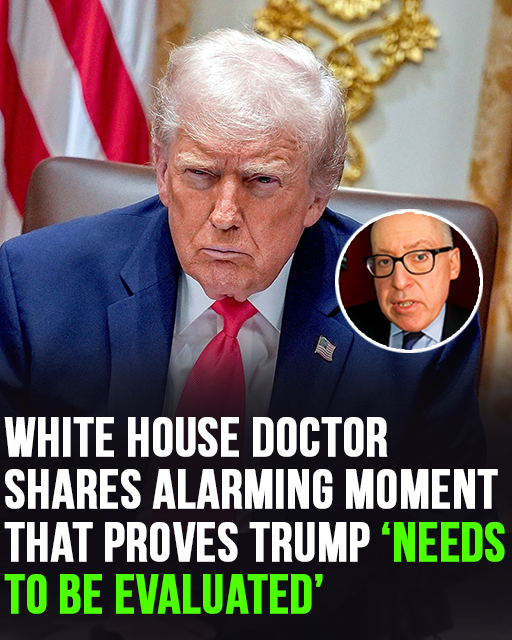
Alarming Oval Office Moment Sparks New Debate Over Trump’s Health: Former White House Doctor Urges Evaluation
In late January 2026, a former White House doctor publicly argued that a single moment involving President Donald J. Trump provided clear evidence that he “needs to be evaluated” — reigniting fierce debate over the president’s physical and cognitive fitness to lead the United States. The comments, made in the context of ongoing scrutiny of Trump’s public demeanor and occasional odd behavior, have drawn sharp responses from medical experts, political allies and opponents, and the White House itself.
The Incident: What Happened in the Oval Office
On January 14, 2026, during an Oval Office ceremony to sign the Whole Milk for Healthy Kids Act, a bill reversing nutritional guidelines to allow full-fat milk in school cafeterias, a clip of President Trump circulated widely on social media. In the footage, Trump is shown sitting at the Resolute Desk with several senior officials nearby. At one point in the event, the president appears to close his eyes and momentarily nod off while attendees wait for him to sign the bill.
This moment — brief but striking — became the focal point of a viral video that sparked concern among some medical professionals and commentators who viewed it as unusual, especially given the formal setting. The video was widely shared across platforms including X (formerly Twitter), where it was discussed both jocularly and with genuine concern.
Former White House Doctor’s Statement
Shortly after the clip went viral, Dr. Jonathan Reiner, a cardiologist and CNN medical expert who previously served as physician to Vice President Dick Cheney, weighed in publicly, stating that the president “needs to be evaluated.” Reiner’s comments were grounded not in a formal examination of Trump but on the publicly available video and interpretation of the behavior observed.
Reiner wrote that Trump “seems to be struggling with excessive daytime somnolence” — a medical term referring to sleepiness during normal waking hours — and his repeated moments of apparent nodding in a room full of officials were “not normal.” He emphasized that such behavior “needs to be evaluated,” calling for a medical assessment rather than a political commentary.
In social media posts accompanying his remarks, Reiner stressed that he was not diagnosing the president with any specific condition but expressing concern that the behavior merited serious and professional medical attention rather than being dismissed.
Broader Medical Commentary and Context
Views From Other Physicians
For instance, other commentators suggested that changes in Trump’s speech patterns and public comportment — including what some perceived as a rapid, “manic” cadence in speeches — merited further evaluation. Reviews of his public address on December 17, 2025 drew comments about a delivery that felt unusually fast and erratic, although interpretations varied widely between commentators and professional observers.
Meanwhile, some physicians drew attention to Trump’s reported regimen of taking unusually high doses of aspirin — which turned into a broader topic of speculation about whether such a practice was medically warranted — illustrating the degree to which elements of the president’s health and self-care have become public discussion points.
Skepticism From Some Health Professionals
It’s important to note that not all medical experts agreed that the Oval Office moment necessarily indicates a medical condition. Many neurologists and geriatric specialists emphasize that isolated clips from public events — where the subject may be tired, bored, or simply blinking — should not be construed as definitive signs of a medical disorder.
Experts caution that diagnosing conditions like hypersomnia, stroke, or cognitive impairment requires controlled clinical evaluation including neurological testing, imaging, and a full medical history — none of which is possible from video alone. Public figures, especially older adults with demanding schedules, can occasionally appear fatigued or distracted without it necessarily indicating a pathological condition.
Nonetheless, the debate over how to interpret such moments reflects broader anxieties about aging leaders in politics, and how age-related changes intersect with public performance and governance.
The White House Response
According to a memo released after Trump’s physical exam in April 2025, Trump was noted to be “fully fit” to serve as commander-in-chief. The results cited robust cardiovascular, pulmonary, neurological, and cognitive performance, based on a series of standard assessments including the Montreal Cognitive Assessment (MoCA) test.
In October 2025, the White House physician also reported that advanced imaging and other screening procedures — described in varying public reports as a CT scan or MRI depending on the account — revealed “perfectly normal” results for internal systems, reinforcing the official position that the president maintained strong overall health.
The White House has described the January video briefly as a moment of fatigue, attributing it to long hours and a demanding schedule, rather than as evidence of any serious medical issue.
Political and Public Reaction
Supporters of President Trump
Republican lawmakers and Trump supporters quickly dismissed calls for evaluation as politically motivated and unfounded. They argue that the president’s decades of public service, active schedule, and continued engagement in national and international issues illustrate his capability.
Continue reading…
