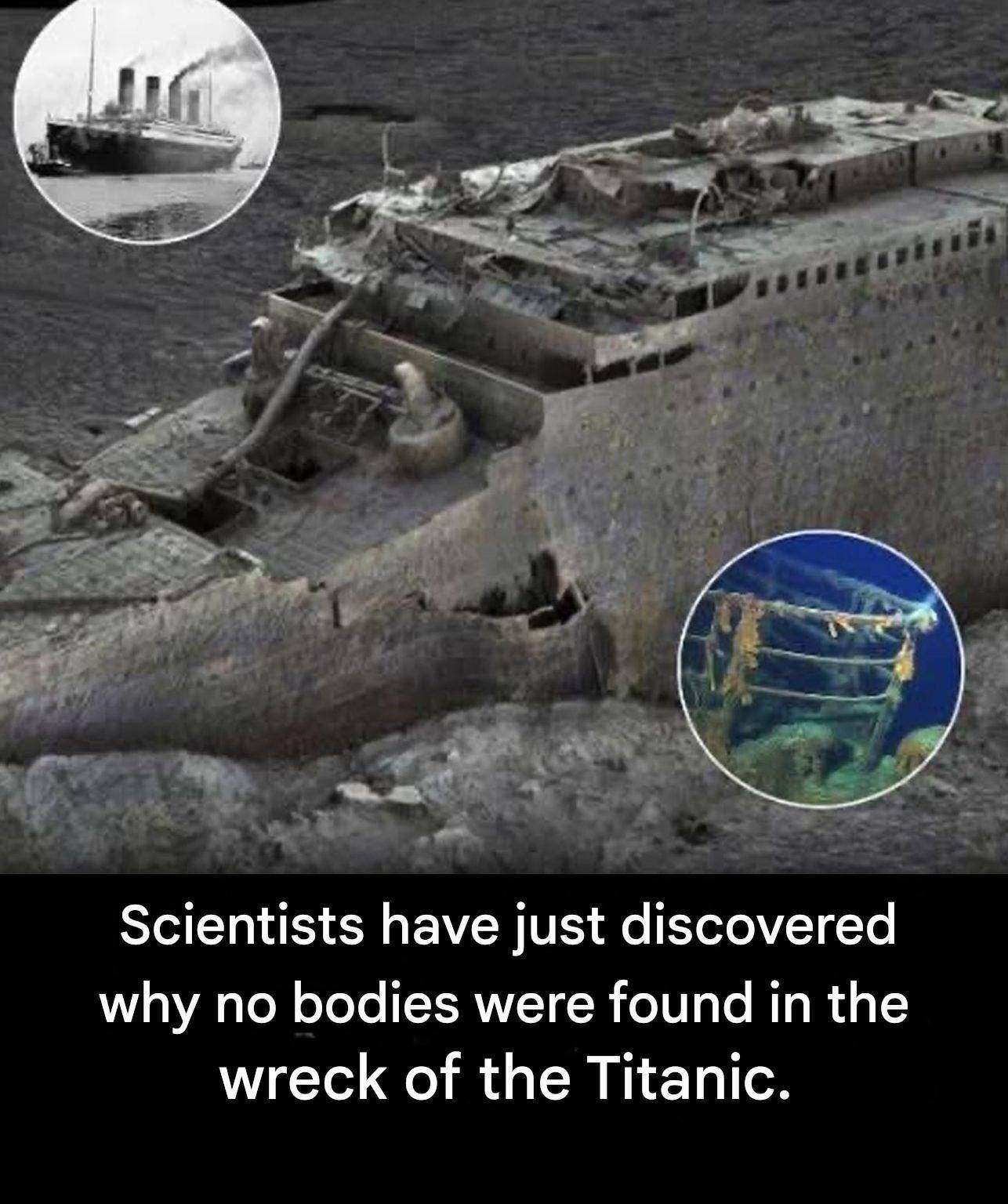
Why Were No Bodies Found in the Wreck of the Titanic?
When the wreck of the RMS Titanic was discovered in 1985, more than seventy years after the ship sank, the world expected grim confirmation of what had long been assumed: the remains of the passengers and crew who perished in one of history’s deadliest maritime disasters. Instead, explorers found something unsettling—the ship was there, personal belongings were there, but human bodies were almost entirely absent.
The lack of bodies in the Titanic wreck is the result of biology, chemistry, oceanography, time, and human decisions, all working together over more than a century. Understanding this phenomenon requires examining what happened immediately after the sinking, what occurs to human remains in the deep ocean, and why the Titanic’s environment is uniquely destructive to bone.
1. The Titanic Disaster: A Brief Context
On April 15, 1912, the RMS Titanic struck an iceberg in the North Atlantic during her maiden voyage from Southampton to New York. In less than three hours, the ship broke apart and sank to the ocean floor nearly 3,800 meters (12,500 feet) below the surface.
Of the approximately 2,224 passengers and crew, more than 1,500 people died. Some drowned immediately, some succumbed to hypothermia in the freezing water, and others were trapped inside the sinking ship.
At the time, recovery efforts focused on the surface. Ships such as the CS Mackay-Bennett retrieved bodies floating in life jackets, but the majority of victims were never recovered. When the wreck was finally located decades later, many assumed those unrecovered bodies would still be there.
They were not.
2. The Immediate Fate of Titanic Victims
Death in the Water
Most Titanic victims died on the surface, not inside the ship. The North Atlantic water temperature that night was approximately −2°C (28°F), below freezing. People who entered the water without protection typically lost consciousness within minutes due to cold shock and hypothermia.
Recovery and Burial at Sea
In the weeks following the disaster, recovery ships retrieved 337 bodies. Of these:
119 were buried at sea, often because they were too decomposed to preserve.
209 were returned to land, mainly to Halifax, Nova Scotia.
Only 59 were never identified.
This means hundreds of bodies were already gone long before the wreck was ever found.
3. Why Bodies Did Not Remain Inside the Wreck
Violent Structural Breakup
As Titanic sank, immense pressure caused the ship to split in two. This breakup released massive air bubbles, debris, and water surges powerful enough to eject objects—and people—from interior spaces.
Escape Attempts
Many passengers and crew attempted to escape upward as the ship flooded. Doors were opened, windows shattered, and corridors flooded rapidly. Bodies were not neatly sealed inside cabins.
Implosion and Collapse
Over time, the wreck itself collapsed. Decks pancaked, walls disintegrated, and interior spaces were crushed. Even if bodies had remained inside initially, they would not have stayed intact.
4. The Deep-Sea Environment: A Perfect Destroyer of Remains
The Titanic rests in one of the most hostile environments on Earth. Conditions at nearly 4,000 meters deep are radically different from shallow water shipwrecks where skeletons are sometimes preserved.
Immense Water Pressure
At Titanic depth, pressure exceeds 6,000 pounds per square inch—enough to crush steel, let alone organic tissue. While pressure alone does not instantly destroy bones, it accelerates structural breakdown once decomposition begins.
Near-Freezing Temperatures
Deep ocean temperatures hover just above freezing. While cold slows decomposition initially, it does not stop it. Over decades, decomposition still occurs—just more gradually.
Complete Darkness
Without sunlight, photosynthetic life is absent, but scavengers and bacteria adapted to darkness thrive.
5. Scavengers of the Deep
One of the most important reasons bodies disappeared is deep-sea scavenging.
Marine Life Consumption
When organic material reaches the ocean floor, it becomes a rare and valuable food source. Titanic victims’ bodies would have attracted:
Deep-sea fish
Crustaceans
Amphipods
Bacteria
These organisms consume soft tissue first, often rapidly.
The “Marine Snow” Effect
As bodies decomposed and broke apart, organic particles drifted downward, feeding entire ecosystems. Over time, nothing substantial remained.
6. Bone Dissolution: The Key Scientific Explanation
Perhaps the most surprising reason bodies are absent is that bones themselves do not last forever in the deep ocean.
Calcium Carbonate and Water Chemistry
Human bones are rich in calcium compounds. At extreme depths, seawater becomes undersaturated with calcium carbonate, meaning it actively dissolves bone material.
This occurs below a depth known as the Carbonate Compensation Depth (CCD). The Titanic lies below this depth.
As a result:
Skeletons gradually dissolve
Teeth may survive longer but eventually degrade
Only non-organic materials persist
This is why explorers have found shoes, leather, and clothing outlines, but no skeletons. Leather survives longer than bone under these conditions.
7. Why Personal Items Remain but Bodies Do Not
Explorers frequently encounter:
Shoes
Eyeglasses
Jewelry
Suitcases
Clothing remnants
These items create haunting impressions of where people once lay.
Shoes as “Markers of Death”
Leather shoes are especially durable. When bodies decomposed, shoes often remained in place, creating the illusion that a body should still be there.
Metal, Glass, and Synthetic Survival
Inorganic materials do not dissolve like bone. Glass, brass, and steel endure—though even these are slowly consumed by rust-eating bacteria.
8. The Role of Time: Over a Century of Decay
The Titanic sank in 1912. That means:
Over 110 years of exposure
Continuous chemical reactions
Constant microbial activity
Ongoing physical collapse
Even bodies preserved in ideal conditions rarely last more than a few decades. In the deep sea, a century is more than enough time for total biological erasure.
9. Why No Mass Graves Exist on the Seafloor
Some imagine the seabed littered with remains. In reality:
Ocean currents disperse material
Bodies would not settle in one place
Scavengers spread remains over wide areas
The seafloor around Titanic is vast. Any remains that once existed are now indistinguishable from the environment.
10. Ethical Considerations and Exploration Rules
Modern expeditions treat the Titanic as a maritime grave site.
No Body Recovery Attempts
Even if remains were found, recovery would be ethically and legally controversial. International agreements discourage disturbing the site.
Respect for the Dead
Explorers document, not disturb. The absence of bodies reinforces the idea that Titanic is a place of memory, not excavation.
11. Addressing Common Myths and Misconceptions
“The Bodies Were Removed”
There is no evidence of large-scale body recovery from the wreck site. Technology did not allow access until 1985.
“The Bodies Are Hidden”
Extensive mapping and submersible exploration show no hidden chambers containing remains.
“They Were Preserved Somewhere Else”
Environmental science strongly contradicts this idea. Conditions simply do not allow preservation.
12. Comparison With Other Shipwrecks
Shallower wrecks, such as those in the Baltic Sea, often contain skeletons because:
Lower salinity
Colder, less acidic water
Fewer scavengers
Titanic’s location makes preservation impossible by comparison.
13. The Titanic as a Lesson in Nature’s Power
Continue reading…
