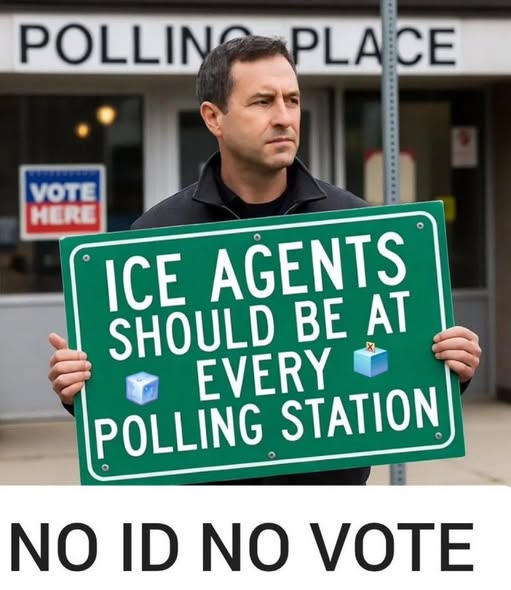
VILLEGALS DON’T VOTE!!
Credit: Shane Morgan
So which is it?
Do “illegals” vote? Are elections being decided by non-citizens? Or is the truth more boring, more bureaucratic, and far less sensational than either side admits?
This blog takes a hard look at the claim behind the slogan “ILLEGALS DON’T VOTE!!”—not as a taunt or talking point, but as a factual question. What does the law actually say? How does voter registration work? Where does confusion come from? And why does this issue refuse to die, even in the face of repeated investigations?
The short version may frustrate people on both sides: non-citizens are prohibited from voting in federal elections, and verified cases of illegal voting are exceedingly rare—but the systems around voting are imperfect, human-run, and often misunderstood.
Understanding that reality requires more nuance than a meme can offer.
1. What the Law Actually Says
Under U.S. federal law, only U.S. citizens may vote in federal elections—president, vice president, U.S. Senate, and U.S. House of Representatives.
This has been clearly established for decades and is enforced through multiple statutes, including the Illegal Immigration Reform and Immigrant Responsibility Act of 1996. Voting illegally in a federal election can result in:
Deportation
Inadmissibility for future legal status
Criminal charges in severe cases
In plain terms: voting illegally is one of the worst possible things an undocumented immigrant could do if they ever hope to remain in the United States.
This alone raises a basic question: Why would someone take such an enormous personal risk for a single vote?
2. Federal vs. Local Elections: Where Confusion Begins
One reason this debate persists is that voting rules are not identical everywhere.
School board races
Municipal referenda
City council elections
These policies are limited, controversial, and clearly defined. Importantly:
They do not apply to federal elections
They usually require separate registration systems
Ballots are restricted to local races only
This distinction is often lost in public discourse. When people hear “non-citizens voting,” they frequently assume it means national elections—when, in rare cases, it refers to narrowly scoped local policies.
3. How Voter Registration Actually Works
Another major misconception is the idea that voting is effortless or automatic.
In reality, voting requires multiple steps:
Registration, often requiring a sworn statement of citizenship
Verification, typically cross-checked with state databases
Ballot issuance, tied to a specific voter record
Post-election audits, in many jurisdictions
When someone registers to vote, they sign a legal attestation—under penalty of perjury—that they are a U.S. citizen. Lying on this form is a felony.
Is the system flawless? No.
Is it wide open? Also no.
Errors can occur, especially due to:
Clerical mistakes
Database mismatches
Confusion at motor vehicle offices
Name similarities
But isolated errors are not the same thing as systemic fraud.
4. What Investigations Have Found
Over the years, multiple investigations—conducted by journalists, academics, state officials, and federal agencies—have looked for evidence of widespread non-citizen voting.
The consistent finding:
Verified cases exist, but they are extremely rare
Numbers are statistically insignificant compared to total votes cast
No evidence shows they alter national election outcomes
Even administrations that aggressively searched for fraud have failed to produce proof of large-scale illegal voting by non-citizens.
This doesn’t mean “zero.” It means “vanishingly small.”
In a nation that conducts hundreds of millions of votes across election cycles, the existence of a few dozen or even a few hundred improper ballots does not support claims of mass manipulation.
5. Why the Myth Persists
If the evidence is so thin, why does this claim endure?
a. Immigration Anxiety
Immigration is emotionally charged. Rapid demographic change creates fear, especially when people feel economically or culturally displaced. Voting becomes a symbolic battleground for those anxieties.
Continue reading…
